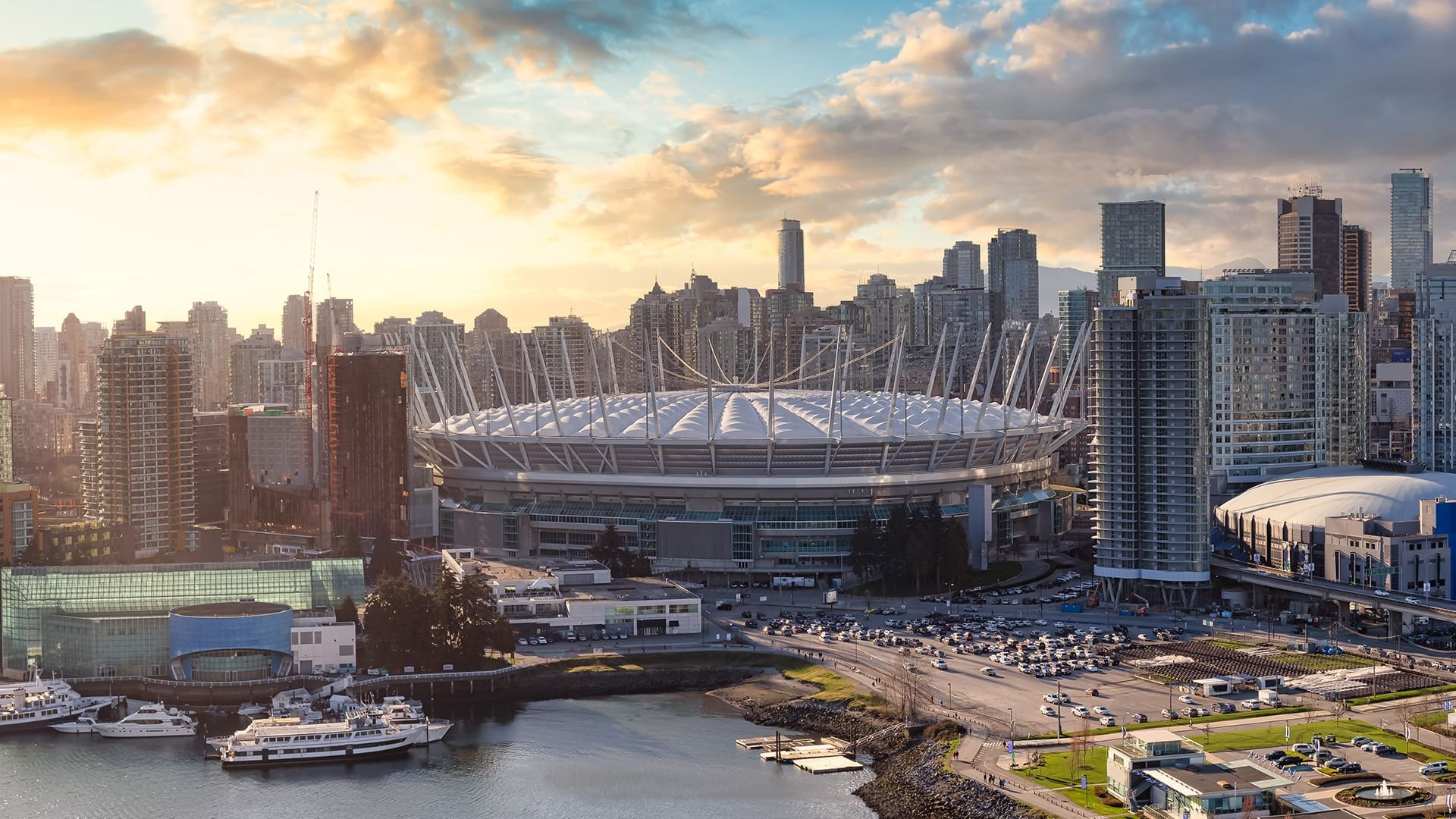
BC Place will be Canada’s busiest venue at the FIFA World Cup 2026, hosting seven matches in Vancouver, British Columbia, including two Canada group-stage games, a Round of 32 match and a Round of 16 fixture.
During the tournament, the venue will be called Vancouver Stadium because FIFA uses neutral venue names and removes commercial branding from World Cup stadiums. But to Canadian sports fans, this is BC Place: the home of Vancouver Whitecaps FC, the BC Lions and some of the biggest events in Canadian sporting history.
Opened in 1983, BC Place sits in downtown Vancouver on the north shore of False Creek. It is surrounded by mountains, water, glass towers, restaurants, hotels and public transport. Unlike many stadiums built around parking lots, this one is embedded in a walkable city centre.
For World Cup 2026, BC Place will replace its FieldTurf surface with natural grass. That conversion will be one of the most important preparations because FIFA requires a high-quality natural playing surface.
The stadium’s seven-match schedule gives Vancouver a major role in the tournament. Canada vs Qatar and Switzerland vs Canada will be headline fixtures, while the Round of 16 match on July 7 gives the venue serious knockout-stage importance.
Quick Facts About BC Place
| Fact | Detail |
|---|---|
| Stadium name | BC Place |
| FIFA World Cup name | Vancouver Stadium |
| Location | Vancouver, British Columbia, Canada |
| Address | 777 Pacific Boulevard, Vancouver, BC V6B 4Y8 |
| Capacity | Approximately 54,500 |
| Opened | 1983 |
| Roof | Retractable, cable-supported |
| Surface | FieldTurf normally; natural grass for FIFA events |
| Main tenants | Vancouver Whitecaps FC and BC Lions |
| Competition focus | FIFA World Cup 2026 |
| World Cup matches | 7 matches |
| Biggest match | Round of 16 |
| First World Cup match | June 13, 2026 |
| Known for | Retractable roof, downtown location, 2010 Winter Olympics, 2015 Women’s World Cup Final and mountain views |
Where Is BC Place?
BC Place is located at 777 Pacific Boulevard in downtown Vancouver, beside False Creek and close to Yaletown, Gastown, Chinatown and the city’s waterfront.
The location is one of the best in the entire World Cup 2026 venue list. Fans can walk from many downtown hotels, reach the stadium by SkyTrain, connect from Vancouver International Airport by rail and enjoy restaurants, parks and waterfront paths before or after matches.
The stadium is directly adjacent to Stadium-Chinatown SkyTrain station, making public transport simple for local and international fans.
BC Place also sits next to Rogers Arena, home of the Vancouver Canucks, and close to Science World, Granville Island, Gastown and the False Creek seawall.
For visitors, Vancouver Stadium will feel like a true city-centre World Cup venue.
History of BC Place
BC Place opened on June 19, 1983, as a major civic stadium built ahead of Expo 86, the World’s Fair that helped transform Vancouver’s global image.
The stadium originally had an air-supported dome, one of the largest of its kind in the world. That white roof became a major part of the Vancouver skyline for decades.
BC Place hosted Expo 86 ceremonies, Grey Cups, concerts, trade shows, football, soccer, rugby and civic events. It also became home to the BC Lions of the Canadian Football League.
In 2010, the stadium hosted the opening and closing ceremonies of the Vancouver Winter Olympics. That event placed BC Place in front of a global audience and cemented its status as one of Canada’s most important event venues.
After the Olympics, the stadium underwent a major renovation, replacing its old air-supported dome with a cable-supported retractable roof. It reopened in 2011 with a completely new identity.
Construction and Design
BC Place was originally designed by Studio Phillips Barratt, with structural engineering by Geiger Berger Associates and construction by Dillingham Construction.
The original stadium used an air-supported roof held up by interior air pressure. At the time, it was one of the most ambitious stadium roof systems in the world.
A major turning point came in 2007, when the air-supported roof tore under snow accumulation and had to be deflated in a controlled response. Although it was repaired, the incident accelerated the push for a permanent roof replacement.
The 2011 renovation gave BC Place its current cable-supported retractable roof. The structure uses 36 steel masts, a large cable network and a retractable centre section that can open or close in about 20 minutes.
The stadium’s exterior also features the Northern Lights Display, a programmable lighting system that transforms the roof into a glowing landmark at night.
This roof gives BC Place one of the most distinctive looks of any World Cup 2026 venue.
BC Place and World Cup 2026
BC Place will host seven FIFA World Cup 2026 matches.
The schedule includes five group-stage games, one Round of 32 fixture and one Round of 16 match. Vancouver will host more matches than Toronto, making it Canada’s busiest World Cup city.
Canada will play two group-stage matches at BC Place: Canada vs Qatar on June 18 and Switzerland vs Canada on June 24. Those fixtures will give the stadium a true home-team atmosphere.
The venue will be temporarily known as Vancouver Stadium during the tournament. That name will appear in FIFA broadcasts, tickets, signage and official material.
The Round of 16 match on July 7 will be the biggest fixture in Vancouver. At that stage, the tournament will be deep into knockout football, and one winner will move closer to the quarterfinals.
World Cup 2026 Matches at BC Place
| Date | Match |
| June 13, 2026 | Australia vs UEFA Playoff C Winner |
| June 18, 2026 | Canada vs Qatar |
| June 21, 2026 | New Zealand vs Egypt |
| June 24, 2026 | Switzerland vs Canada |
| June 26, 2026 | New Zealand vs Belgium |
| July 2, 2026 | Round of 32 |
| July 7, 2026 | Round of 16 |
This schedule gives BC Place one of the strongest Canadian World Cup profiles. Canada will play twice in Vancouver, while Egypt, Belgium, Australia, New Zealand, Switzerland and Qatar add international variety.
For African readers, New Zealand vs Egypt on June 21 is especially important. Egypt will bring African and Arab football interest to Vancouver, making BC Place relevant beyond Canada’s national team story.
The Round of 16 fixture will be the stadium’s biggest global match, giving Vancouver knockout-stage visibility.
Why BC Place Was Chosen for a Round of 16 Match
BC Place was chosen for a Round of 16 match because it offers strong event experience, a central city location, excellent transport access and a proven international-event record.
The stadium has hosted the 2010 Winter Olympics ceremonies, the 2015 FIFA Women’s World Cup Final, multiple Grey Cups, rugby sevens, concerts and major soccer matches. That gives it a long record of handling global attention.
Vancouver also provides FIFA with one of the most attractive host-city settings in the tournament. The city combines mountains, ocean, hotels, restaurants, public transport and a compact downtown core.
The stadium’s retractable roof adds flexibility, while its location beside SkyTrain gives fans easy access.
A Round of 16 match requires more than seats. It needs reliable operations, media infrastructure, security, fan movement and a strong visual setting. BC Place provides all of that.
Natural Grass for FIFA Events
BC Place normally uses FieldTurf, but FIFA World Cup 2026 matches will be played on natural grass.
The grass will be grown in British Columbia’s Fraser Valley and installed for the tournament. That process is important because the stadium’s regular synthetic surface cannot be used for World Cup matches.
Natural grass must support quick passing, stable footing, safe tackles and consistent ball movement. Because BC Place is a multi-use stadium with a roof and artificial surface history, the conversion will be closely watched.
The pitch will need careful preparation, drainage, root stability and maintenance throughout seven matches.
For players, the quality of the grass could influence tempo, pressing and confidence on the ball.
The Retractable Roof Advantage
BC Place has one of the most impressive retractable roofs in world sport.
The current roof replaced the old air-supported dome in 2011. Its cable-supported design allows the centre section to open or close in about 20 minutes.
For World Cup 2026, the roof gives organisers flexibility. Vancouver summer weather is usually pleasant, but rain is always possible in the Pacific Northwest. The roof can help manage conditions and improve fan comfort.
Even when the roof is open, the stadium retains a strong acoustic feel. When closed, it can trap sound and create a more intense environment.
For Canada matches, that could make BC Place one of the loudest venues in the tournament.
Vancouver Weather and Match Conditions
Vancouver in June and July usually offers some of the best conditions among World Cup 2026 host cities.
Temperatures are generally mild, humidity is lower than in many eastern or southern venues, and summer brings long daylight hours. Rain is less frequent than in winter, though showers can still happen.
Evening matches can feel cool, especially near the water or with the roof open. Fans should bring light layers, even if the day starts warm.
For players, Vancouver’s climate should be more comfortable than the extreme heat of Monterrey, Houston or some U.S. venues. That could support a faster tempo and better recovery.
The combination of mild weather, natural grass and a retractable roof should make BC Place a strong match venue.
Canada’s Home World Cup Matches in Vancouver
Canada will play two group-stage matches at BC Place.
The first will be Canada vs Qatar on June 18. That match will be one of the biggest moments in Canadian men’s football history because the national team will play a World Cup match at home in Vancouver.
The second will be Switzerland vs Canada on June 24. That final group-stage match could decide whether Canada advances to the knockout rounds.
The atmosphere for both matches should be intense. Vancouver has a strong soccer culture, and Canadian fans from across British Columbia and beyond will travel to support the team.
If Canada needs a result against Switzerland, BC Place could become one of the loudest stadiums in the tournament.
Vancouver Whitecaps and Soccer Culture
BC Place is home to Vancouver Whitecaps FC of Major League Soccer.
The Whitecaps have helped build the city’s modern soccer culture, with supporter groups, MLS matches and Canadian Championship fixtures bringing regular football energy to the stadium.
Vancouver also has a long soccer history that predates MLS. The Whitecaps name reaches back to earlier professional soccer eras, and the city has hosted important international and domestic matches for decades.
The 2015 FIFA Women’s World Cup Final at BC Place was another major soccer milestone. The United States beat Japan 5-2 in that final, with Carli Lloyd scoring a famous hat trick.
World Cup 2026 will add the men’s tournament to Vancouver’s football resume.
Major Events Hosted at BC Place
BC Place has one of the strongest event resumes of any Canadian stadium.
It hosted the opening and closing ceremonies of the 2010 Vancouver Winter Olympics. It staged the 2015 FIFA Women’s World Cup Final. It has hosted multiple Grey Cups, major concerts, rugby sevens and international soccer.
The stadium was also central to Expo 86, a World’s Fair that helped reshape Vancouver’s identity and waterfront.
These events show why BC Place is trusted for World Cup matches. It has repeatedly handled international crowds, global broadcasting, ceremonies, security and large-scale event logistics.
The 2026 World Cup will be the next major chapter in that history.
Transport and Fan Access
BC Place has excellent public transport access.
The SkyTrain Expo Line stops at Stadium-Chinatown station, directly beside the stadium. Fans can reach the venue from downtown, Burnaby, New Westminster, Surrey and other parts of Metro Vancouver.
From Vancouver International Airport, fans can take the Canada Line into downtown and transfer to the Expo Line. The total rail journey to the stadium area is practical and visitor-friendly.
Yaletown-Roundhouse station on the Canada Line is also within walking distance for fans staying in Yaletown or around False Creek.
For World Cup matches, transit will be crowded, but the system gives Vancouver one of the strongest stadium-access profiles in the tournament.
Driving and Parking
Driving to BC Place is possible, but it is not recommended for most World Cup fans.
The stadium is located in downtown Vancouver, where traffic, road closures and parking demand can create delays. Match-day security zones may also restrict access near the venue.
Parking lots and garages exist around Yaletown, False Creek and the stadium area, but spaces will be limited and expensive during World Cup matches.
Fans staying downtown should walk or use transit. Visitors from outside the city should consider SkyTrain, park-and-ride options or official transport guidance.
For a venue this central, driving should be a last choice.
Rideshare and Airport Access
Uber, Lyft and taxis operate in Vancouver and will serve the stadium area during the World Cup.
Rideshare may be useful for fans staying outside rail corridors, but post-match surge pricing and delays are likely. Walking a few blocks away from the stadium before requesting a ride may reduce waiting time.
Vancouver International Airport is about 9 miles south of BC Place. The Canada Line gives fans a strong rail option directly from the airport to downtown, with a transfer to reach Stadium-Chinatown.
This airport-to-stadium connection is one of the best among World Cup 2026 venues.
International visitors should still allow extra time for arrivals, luggage, transit and security screening.
Walking to BC Place
BC Place is one of the most walkable stadiums in the tournament.
Fans staying in Yaletown can reach the stadium in about 5 to 10 minutes. Gastown, Chinatown, the waterfront and parts of downtown are also within easy walking distance.
The False Creek seawall offers one of the most scenic approaches to any World Cup venue. Fans can walk beside the water, with views of the skyline, mountains and stadium roof.
Walking also helps after matches because SkyTrain stations and roads will be crowded. Many visitors may choose to walk toward Yaletown, Gastown, Granville Island ferry points or downtown hotels.
For match-day experience, Vancouver may be one of the best host cities for pedestrians.
Nearby Attractions
BC Place sits close to several major Vancouver attractions.
Science World is a short walk away at the eastern end of False Creek. Rogers Arena sits next door. Gastown and Chinatown are nearby, offering restaurants, bars, historic streets and cultural landmarks.
Granville Island Public Market is reachable by walking, ferry or short transit trip. Stanley Park and English Bay are also close enough for visitors staying in the downtown core.
The False Creek seawall connects many of these areas, making it easy to build a full match-day plan around walking, food, sightseeing and football.
Few World Cup venues will offer a better combination of stadium access and tourism.
What Fans Should Know Before Visiting
Fans attending World Cup matches at BC Place should use public transport or walk where possible.
The stadium is downtown, so driving will be difficult on match days. SkyTrain, walking routes and airport rail connections are the best options for most visitors.
The roof provides weather flexibility, but fans should still check conditions. Vancouver evenings can be cool, even in summer.
Security will follow FIFA standards. Ticket holders should check official rules on bags, entry gates, prohibited items and arrival times before match day.
For Canada matches and knockout fixtures, crowds will be especially heavy. Arriving early and avoiding tight post-match plans will make the experience easier.
Why BC Place Matters to African Fans
BC Place will matter to African football fans because Egypt will play New Zealand there on June 21.
Egypt is one of Africa’s most historic football nations, with a strong continental record and a passionate fan base across North Africa and the Arab world.
For Kenyan readers, Egypt’s match in Vancouver gives BC Place direct African relevance. If Egypt starts well in the group, its Vancouver fixture could become important to its qualification path.
The Round of 16 match also matters. If an African team advances into that part of the bracket and lands in Vancouver, BC Place could become part of a major continental story.
Why BC Place Is Important
BC Place is important because it gives Canada a major World Cup stage on the Pacific coast.
Toronto will host Canada’s first men’s World Cup match, but Vancouver will host more Canadian matches and a deeper knockout fixture. That makes BC Place central to the country’s tournament identity.
The stadium combines global-event experience, a dramatic downtown location, strong transit access, a retractable roof and a scenic setting. It is not the largest venue in World Cup 2026, but it may be one of the most beautiful and accessible.
For Canada, Vancouver Stadium will be more than a host venue. It could become the place where the national team fights for knockout qualification.
Key Takeaways
- BC Place is located in downtown Vancouver.
- It will be called Vancouver Stadium during FIFA World Cup 2026.
- The stadium opened in 1983.
- It has a capacity of about 54,500.
- It is home to Vancouver Whitecaps FC and the BC Lions.
- BC Place has a cable-supported retractable roof.
- The venue normally uses FieldTurf but will use natural grass for FIFA events.
- It will host seven World Cup 2026 matches.
- Canada will play Qatar and Switzerland there.
- The stadium will host a Round of 32 match and a Round of 16 match.
- Egypt will play New Zealand at BC Place.
- SkyTrain gives the stadium excellent public transport access.
Frequently Asked Questions
Where is BC Place located?
BC Place is located at 777 Pacific Boulevard in downtown Vancouver, British Columbia, beside False Creek.
What will BC Place be called during World Cup 2026?
During the tournament, BC Place will be called Vancouver Stadium because FIFA uses neutral venue names.
What is BC Place’s capacity?
BC Place has a capacity of approximately 54,500 for sporting events.
When did BC Place open?
BC Place opened on June 19, 1983.
Which teams play at BC Place?
The stadium is home to Vancouver Whitecaps FC of MLS and the BC Lions of the Canadian Football League.
Read Also: Mexico vs South Africa Live: World Cup Match Updates
Does BC Place have a retractable roof?
Yes. BC Place has a cable-supported retractable roof that can open or close in about 20 minutes.
Will BC Place use natural grass for World Cup 2026?
Yes. BC Place will install natural grass for FIFA World Cup 2026 matches.
How many World Cup 2026 matches will BC Place host?
BC Place will host seven matches during FIFA World Cup 2026.
Will Canada play at BC Place?
Yes. Canada will play Qatar on June 18 and Switzerland on June 24 at BC Place.
Will BC Place host a World Cup knockout match?
Yes. BC Place will host both a Round of 32 match and a Round of 16 match.
Conclusion
BC Place will be one of the most important Canadian venues at the FIFA World Cup 2026. With seven matches, two Canada fixtures, a Round of 32 and a Round of 16, Vancouver will play a major role in the tournament.
The stadium offers a powerful combination of downtown location, SkyTrain access, retractable roof flexibility, mountain-and-water scenery and major-event experience. Its natural grass conversion will be one of the key technical preparations before the first match.
For Canada, BC Place could become the stadium where the national team’s group-stage fate is decided. For African fans, Egypt’s match and the knockout-round possibilities give the venue wider relevance.
On July 7, 2026, Vancouver Stadium will host Round of 16 football. If the city, the roof and the crowd all deliver, BC Place could produce one of the most memorable nights of the tournament.
Read Also: BC Place World Cup 2026 Guide: Capacity, Location, Matches and Round of 16 Venue
