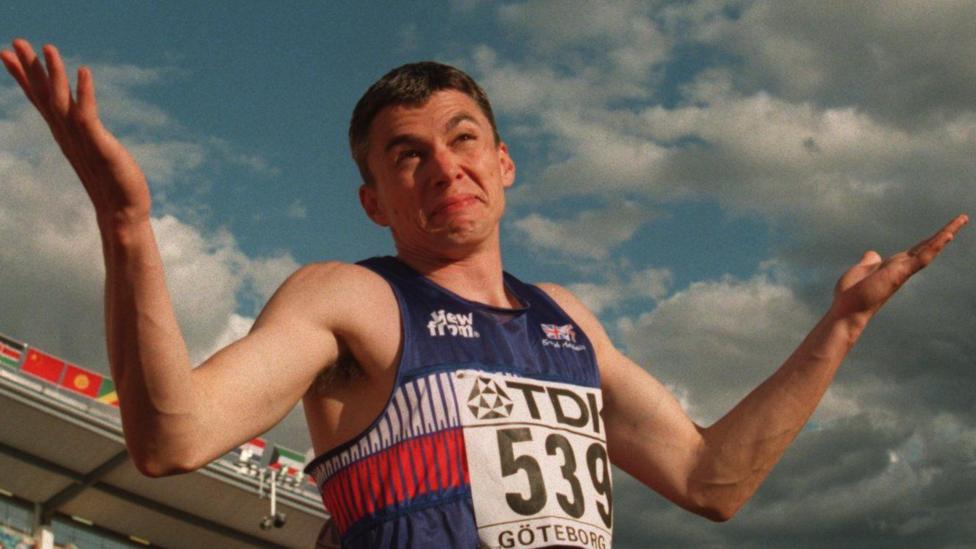
Jonathan Edwards’ triple jump world record has stood unbroken since 1995. He leapt 18.29 meters at the World Championships in Gothenburg, setting a benchmark that remains unmatched after 30 years. While he’s proud of the record, he questions what its longevity says about the state of athletics.
He admits the lack of progression raises concerns. With major advancements in sports science, nutrition, and training, he believes the sport may not be thriving. Remarkably, only seven men in history have ever cleared 18 meters, making his achievement even more extraordinary.
In 1995, Edwards rewrote the record books not once, but twice, at a time when no athlete had legally jumped over 18 meters. His opening jump was 18.16 meters. Just 20 minutes later, he stretched the record to 18.29 meters, delivering one of Britain’s most iconic track and field performances.
He arrived at the championships as the world record holder, having jumped 17.98 meters to edge out Willie Banks’ long-standing mark. He also recorded a wind-assisted 18.43 meters, showing consistent dominance. Edwards credits much of his success to his sprinting speed, light body weight, and a change in technique. By shifting to a double arm action, he improved balance and execution during all three phases of the triple jump.
Yet, even as the favorite, he was not confident. He bought sunglasses at the airport to hide his nerves from competitors during warm-ups. Still, his competitors admired him deeply. Bronze medalist Jerome Romain recalled watching Edwards’ training footage obsessively. Silver medalist Brian Wellman said Edwards was the most efficient triple jumper he had ever seen.
Edwards believes the sport hasn’t kept pace with the professionalization seen elsewhere. Today, promising young athletes choose more lucrative sports, especially track events over field events. Prize money and exposure remain limited. He points to Grand Slam Track, a new initiative led by Michael Johnson offering large prizes for track events only, as proof of the shift.
He also highlights falling investment. UK Athletics, for instance, received an 8% funding cut for the Los Angeles 2028 Games. Participation levels in track and field are also declining, especially among youth.
Technology hasn’t necessarily helped field events. Though sprint records have fallen thanks to carbon-fiber-plated shoes, such footwear offers no real benefit in the triple jump, high jump, or long jump. The forces during take-off are so extreme that the spring-like effect seen in running events doesn’t translate to jumping. Sports engineers confirm these shoes may offer minimal or no advantage in jumps.
Even with technological evolution, the closest anyone has come to Jonathan Edwards’ triple jump record was Christian Taylor’s 18.21 meters in 2015. The leading jump in 2025 stands at 17.80 meters, well below the record.
Edwards himself reflects with humility. He doesn’t know how he’ll feel if someone breaks his record. Still, he jokes that 18.29 meters could be engraved at his funeral. After three decades, his name remains immortalized not just on paper, but in British athletics history and even mosaics back in his hometown of Ilfracombe.
READ: Sinner Eyes Cincinnati Title Defence After Wimbledon Break
