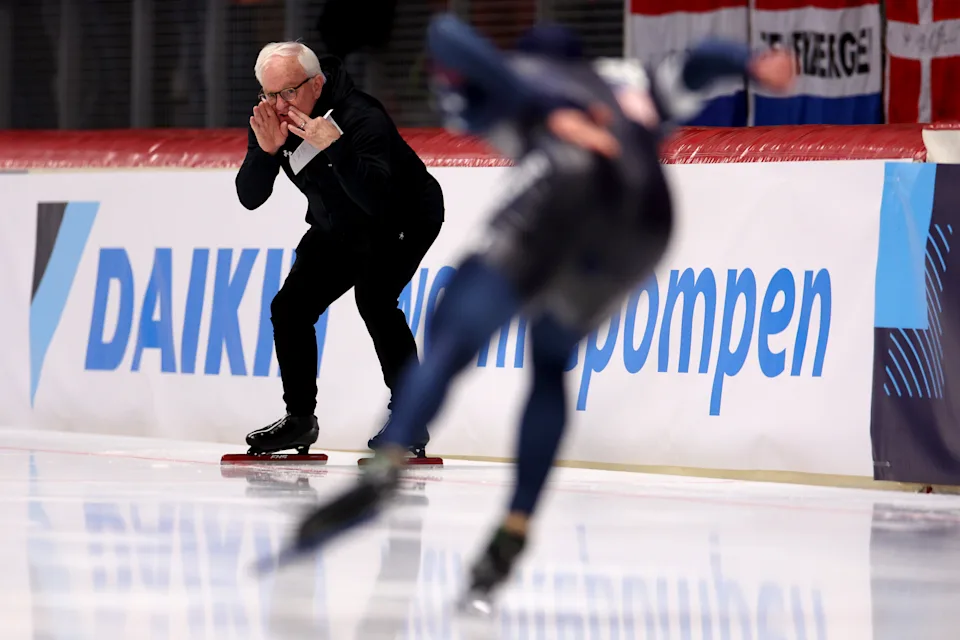
Last Wednesday night, shortly after 1 a.m., Jordan Stolz’s coach went to speak with the speedskating superstar. Bob Corby found Stolz in the Olympic Village, still cradling the gold medal secured earlier that evening. The 21-year-old had won his first of four races on the sport’s biggest stage.
Oh, you got a little trophy there? the 75-year-old Corby quipped. What did you do? Did you win a little tee ball tournament? Stolz grinned before gesturing toward his medal. I’ve been thinking about this for a long time, he said.
At first glance, Stolz and Corby might appear mismatched. An unflappable young phenom pairs with a feisty white-haired grandfather lured out of retirement. However, speedskating’s odd couple have brought out the best in each other during seven years working together. Stolz has flourished under Corby’s old-school training methods. He has established himself as the planet’s most dominant speedskater. He has a real chance to add two more Olympic gold medals in Milan.
The Skate Whisperer
The only speedskater ever to win five gold medals at the same Olympics endorsed Corby. Eric Heiden used to train with Corby. To this day, Heiden refers to him as the Skate Whisperer. He doesn’t let his ego get in the way of letting Jordan do his thing, Heiden said, He knows when to offer advice and coach. He also understands when to let Jordan’s innate talent take over.
Corby’s journey to becoming Jordan Stolz’s coach began decades ago. He once had aspirations of competing at an Olympics himself, He trained relentlessly for the 1972 and 1976 Winter Games, He experimented with yoga, nutrition and various drills. He tried to shave tenths of a second off his best times. Ultimately, it wasn’t enough. There were always world-class American skaters faster than Corby. Nevertheless, those experiences helped him as a coach later in life.
Early Coaching Career
Corby started working for the Madison Speedskating Club. He also joined the U.S. International Speedskating Association. Simultaneously, he studied physical therapy at the University of Wisconsin. One year after Heiden’s 1980 Olympic sweep, the USISA tasked Corby with a major responsibility. He would help prepare American speedskaters for the 1984 Olympics in Sarajevo. He inherited a young, inexperienced group. Heiden and many top Americans had chosen to retire.
The buildup to the Sarajevo Games faced significant challenges. Infighting marred preparations over staff shortages. Fundraising failures created financial constraints. Disagreements over training sites and coaching methods persisted. Reports describe a schism between skaters who supported Corby and those backing other coaches. The results once the Olympics started were deflating. The Soviets and East Germans dominated competition. The Americans came home empty-handed.
Sarajevo Disappointment
Dan Jansen took fourth in the men’s 500 at 18 years old. Nick Thometz finished one spot behind Jansen in the 500. He also took a hard-luck fourth in the 1,000. Bonnie Blair cracked the top 10 in the women’s 500. However, no American medalists emerged, not even a paltry bronze. It was very disappointing, Corby said. You knew they were teenagers skating against more experienced athletes. It still was disappointing to go through it without a medal. I spent a long time analyzing if I could have changed things.
Corby stepped away from the national team after 1984. He continued coaching speedskaters into the late 1980s. Gradually, he disappeared from the sport altogether. His physical therapy practice began getting busier. His kids showed preference for soccer and skiing instead of speedskating.
First Meeting with Stolz
The first time Corby met Stolz, he had no intention of coaching him. Speedskating coach Bobby Fenn invited him to watch a short-track meet in Madison. Fenn was a longtime close friend of Corby’s. When they arrived, Fenn pointed to a rail-thin 12-year-old boy. Watch this kid, Fenn told Corby. He’s pretty good.
Corby recognized Stolz had potential after watching him skate. He met Stolz and his parents that day through Fenn, He stayed in touch sporadically over subsequent years. He even provided physical therapy after Stolz suffered a hip flexor. By then, Stolz’s ambitions had outgrown the backyard pond where he learned to skate. His parents took him to Milwaukee several times weekly to work with Fenn. Fenn was best known for developing Shani Davis into an Olympic champion.
Tragedy and Transition
Then on Oct. 8, 2017, Fenn didn’t show up for a scheduled practice. Later that day, the Stolz family learned the 73-year-old had passed away suddenly. The cause of death was reportedly a heart attack. Fenn’s death was very hard on both her children, Jane Stolz said. Hannah gradually retreated from speedskating. She preferred focusing on her passion for raising exotic birds. Jordan also drifted without his coach. Davis filled in for Fenn temporarily. When Davis accepted an opportunity to coach in China, Jordan was coachless again.
Corby had occasionally offered guidance during this period. However, Jordan needed more than sporadic support. He asked Corby if he’d return to speedskating full-time. Corby hadn’t coached actively for more than two decades. The timing, as Corby puts it, was serendipitous. He was preparing to step back from his physical therapy practice. Plus, Corby says, how do you say no to a 14-year-old who asks for help?
Training Philosophy
Armed with pages of handwritten notes, Corby tailored a plan specifically for Stolz. He kept certain techniques from the 1984 buildup. He scrapped others that hadn’t proven effective. Stolz spends much of his summer on his bicycle. This builds leg strength and aerobic capacity. He powers through draining sets of heavy squats. Explosive jumps and single-leg workouts feature prominently. He hones technique away from the ice using a slide board. Cables serve as resistance tools to simulate cornering.
The emphasis on weight training transformed Stolz physically. He evolved from a talented but scrawny kid into a powerhouse. By the time speedskating emerged from the COVID pandemic, Stolz stood out nationally. At 16, he took on the fastest men in America and beat them. He clocked a national junior record time of 34.99 seconds in the men’s 500. I remember thinking, ‘Holy cow,’ Corby said. This kid really has some talent.
Remarkable Achievements
The holy cow moments didn’t stop there. At 17, Stolz won both the men’s 500 and 1,000 at U.S. Olympic Trials. He qualified for the Winter Games in both events. At 18, he swept gold medals in the 500, 1,000 and 1,500 at world championships. At 19, he did it again. Now Stolz is trying to top those feats at these Winter Games. He’s halfway to four gold medals already. He set a pair of Olympic records while outdueling Dutch sprinter Jenning de Boo. He won the 1,000 and the 500 in dominant fashion.
Upcoming Races
Stolz will be a heavy favorite to win his third gold medal on Thursday. The 1,500 is a distance he has dominated on the World Cup circuit. Then there’s the race Stolz refers to as a bonus. The chaotic, unpredictable mass start offers another opportunity. When asked why the partnership works so well, Corby noted Stolz responds to being pushed. He responds especially when results show training programs are working.
He can handle a pretty big workload, Corby said, saw real benefit from doing these workouts. Spend even a few minutes at the speedskating arena on race days. The bond between Stolz and Corby becomes immediately obvious. Corby is the last person Stolz speaks with before a race. He’s the first person Stolz high-fives after crossing the finish line.
Vindication at Last
For Corby, Stolz’s success represents something deeper than Olympic medals. It offers redemption for the disappointment of Sarajevo four decades ago. The coach who left the 1984 Games empty-handed has now guided a skater to multiple golds. This experience has been great, Corby said with a laugh. It doesn’t seem to bother him having a white-haired guy hanging around.
Jordan Stolz’s coach has found renewed purpose in his sunset years. The physical therapist turned speedskating mentor has shaped a champion. Their seven-year journey together continues unfolding in Milan. Two more gold medals remain within reach. Regardless of outcomes, their partnership has already produced something special. A grandfather and his prodigy have captured the world’s attention. They’ve done it through trust, hard work and mutual respect.
