BMO Field will be one of Canada’s two FIFA World Cup 2026 venues, hosting six matches in Toronto, Ontario, including Canada’s first men’s World Cup match on home soil.
During the tournament, the stadium will be called Toronto Stadium because FIFA uses neutral venue names and removes commercial branding from World Cup venues. But to Canadian football fans, this is BMO Field: the home of Toronto FC, the Toronto Argonauts and the Canada men’s national team.
Opened in 2007, BMO Field was Canada’s first soccer-specific stadium. It helped launch Toronto FC, strengthened Major League Soccer in Canada and became the home of a passionate supporter culture that changed the country’s football landscape.
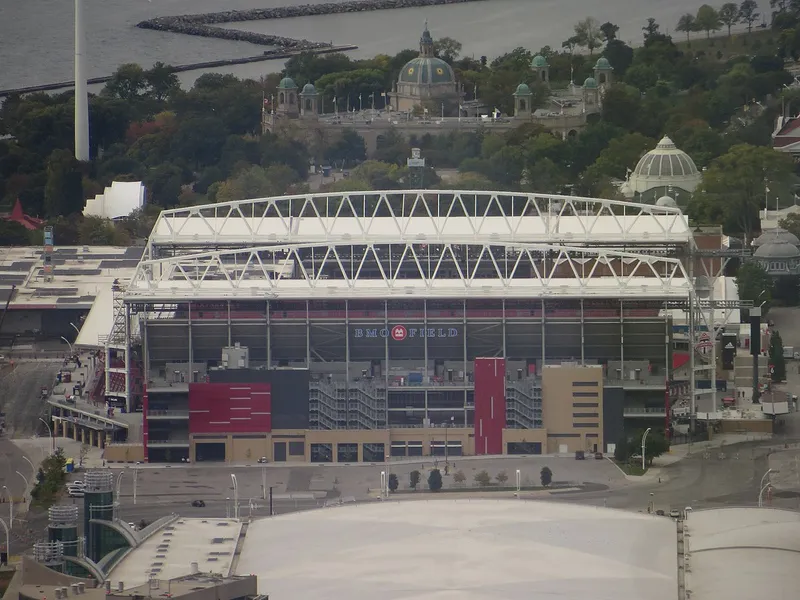
For World Cup 2026, the stadium is being expanded from its standard 30,000 capacity to 45,736 seats. That temporary expansion will allow Toronto to stage five group-stage matches and one Round of 32 knockout fixture.
The biggest match will come immediately. On June 12, 2026, Canada will play Bosnia and Herzegovina in Toronto, marking the first men’s FIFA World Cup match ever played in Canada.
Quick Facts About BMO Field
| Fact | Detail |
|---|---|
| Stadium name | BMO Field |
| FIFA World Cup name | Toronto Stadium |
| Location | Toronto, Ontario, Canada |
| Address | 170 Princes’ Boulevard, Toronto, ON M6K 3C3 |
| Standard capacity | 30,000 |
| World Cup capacity | 45,736 |
| Opened | 2007 |
| Roof | Partial canopy |
| Surface | SISGrass hybrid, mostly natural grass |
| Main tenants | Toronto FC, Toronto Argonauts, Canada men’s national team |
| Competition focus | FIFA World Cup 2026 |
| World Cup matches | 6 matches |
| Biggest match | Canada vs Bosnia and Herzegovina |
| First World Cup match | June 12, 2026 |
| Known for | Canada soccer, Toronto FC supporters, waterfront location and multicultural atmosphere |
Where Is BMO Field?
BMO Field is located at Exhibition Place on Toronto’s Lake Ontario waterfront. The stadium sits just west of downtown Toronto, close to the CN Tower, Rogers Centre, Harbourfront, Liberty Village and the city’s entertainment district.
This location is one of BMO Field’s strongest advantages. Unlike many North American stadiums built around large suburban parking lots, BMO Field is close to transit, downtown hotels, restaurants and tourist attractions.
Fans can reach the stadium by GO Train, TTC streetcar, bus, rideshare, walking routes and airport rail connections. Exhibition Station is nearby, while streetcars stop at Exhibition Loop.
For World Cup visitors, Toronto Stadium will be one of the easiest venues to combine with a city trip. Fans can watch a match, visit the waterfront, see the CN Tower and explore downtown without needing a long suburban commute.
History of BMO Field
BMO Field opened on April 28, 2007, as Canada’s first soccer-specific stadium.
It was built at Exhibition Place, on land with a long sporting history. The site had previously hosted Exhibition Stadium, the former home of the Toronto Blue Jays and Toronto Argonauts.
The stadium was created as the home of Toronto FC, Canada’s first Major League Soccer franchise. Toronto FC’s arrival changed the country’s club football culture almost immediately.
The team struggled in its early years, but the supporters did not. Groups such as the Red Patch Boys and other South End fans created a loud, organised and emotional match-day culture that helped set a new standard for MLS support.
BMO Field also became an important national-team venue. Canada used it for World Cup qualifiers, Gold Cup matches and other major fixtures.
By 2026, the stadium will move from national football landmark to World Cup venue.
Construction and Design
BMO Field was designed by Brisbin Brooks Beynon Architects, with engineering by Halcrow Yolles and construction by PCL Construction.
The original stadium cost CAD$62.9 million and had a capacity of about 20,000. It was modest compared with many World Cup venues, but it was built specifically for soccer and gave Toronto FC a proper home.
Over time, the stadium expanded. A major renovation between 2014 and 2016 added seating, improved facilities and installed a partial canopy roof over the east, west and south stands.
That expansion also allowed the Toronto Argonauts of the Canadian Football League to move into BMO Field. The venue became a multi-sport stadium while keeping its soccer identity.
For World Cup 2026, another major transformation is adding temporary seats, new broadcast systems, upgraded lighting, hospitality spaces, player facilities and a FIFA-standard pitch.
BMO Field and World Cup 2026
BMO Field will host six FIFA World Cup 2026 matches.
The schedule includes five group-stage matches and one Round of 32 knockout fixture. The first match is Canada vs Bosnia and Herzegovina on June 12, 2026.
That game will be historic because it will be the first men’s FIFA World Cup match played on Canadian soil. Canada co-hosted the tournament for the first time in 2026 alongside the United States and Mexico.
The venue will be called Toronto Stadium during the tournament. That name will appear in FIFA broadcasts, signage, tickets and official material.
Toronto will be one of two Canadian host cities, alongside Vancouver. Together, they will give Canada a central role in the first 48-team World Cup.
World Cup 2026 Matches at BMO Field
| Date | Time | Match |
| June 12, 2026 | 3:00 PM ET | Canada vs Bosnia and Herzegovina |
| June 17, 2026 | 7:00 PM ET | Ghana vs Panama |
| June 20, 2026 | 4:00 PM ET | Germany vs Côte d’Ivoire |
| June 23, 2026 | 7:00 PM ET | Croatia vs Panama |
| June 26, 2026 | 3:00 PM ET | Senegal vs Iraq |
| July 2, 2026 | 7:00 PM ET | Round of 32 |
This schedule gives BMO Field one of the most multicultural match slates in the tournament.
Canada’s opener will be the emotional centrepiece. Ghana vs Panama and Germany vs Côte d’Ivoire will bring major African interest, while Senegal vs Iraq gives another African team a chance to shape the group stage in Toronto.
For Kenyan readers and African football fans, BMO Field will be one of the most important Canadian venues to follow because Ghana, Côte d’Ivoire and Senegal all appear on its schedule.
Why BMO Field Was Chosen for a Round of 32 Match
BMO Field was chosen for a Round of 32 match because it gives FIFA a compact, football-focused stadium in Canada’s largest city.
Toronto is one of North America’s most multicultural cities, with large communities connected to countries across Europe, Africa, Asia, the Caribbean, the Middle East and Latin America. That makes it a natural World Cup city.
The stadium’s location also helps. It is close to downtown, public transport, airports, hotels and major attractions. That is important for visiting fans, media, sponsors and tournament operations.
BMO Field may be smaller than most World Cup 2026 stadiums, but its temporary expansion brings it above the required tournament scale. Its football-specific identity also gives it an atmosphere that larger converted stadiums may struggle to match.
The Round of 32 fixture gives Toronto knockout-stage importance after the group phase.
World Cup Expansion and Temporary Seating
BMO Field’s standard capacity is about 30,000, which is too small for a men’s World Cup venue.
For FIFA World Cup 2026, the stadium is being expanded to 45,736 seats through temporary grandstands and permanent upgrades. More than 17,000 temporary seats are being added, mostly at the north and south ends.
The project also includes new LED videoboards, improved lighting, better broadcast facilities, upgraded Wi-Fi, new hospitality areas, player-space improvements and a new FIFA-standard pitch.
This transformation is important because it allows Toronto to host World Cup matches without building a completely new stadium.
After the tournament, several upgrades will continue to benefit Toronto FC, the Argonauts and Canada’s national teams.
SISGrass Hybrid Pitch
BMO Field uses a SISGrass hybrid surface.
This system is mostly natural grass reinforced with synthetic fibres. The fibres help stabilise the surface, reduce wear and support quicker recovery between events.
That is useful because BMO Field hosts soccer and Canadian football. The venue must handle different field markings, player movements and seasonal conditions.
An under-field heating system helps the grass survive Toronto’s cold spring and fall weather. That has been important for national-team matches and MLS games.
For World Cup 2026, the pitch must meet FIFA standards for elite international football. A stable surface will be essential for teams such as Canada, Germany, Ghana, Côte d’Ivoire and Senegal.
Toronto Weather and Match Conditions
Toronto in June and early July is usually warm, active and comfortable for outdoor sport.
Daytime temperatures can be warm, while evenings are often pleasant near the waterfront. Humidity can rise, and summer storms are possible, but the city should offer more moderate conditions than hotter World Cup venues in Mexico and the southern United States.
BMO Field has a partial canopy that covers many seats, but some areas remain open to the weather. Fans should prepare for sun, rain or cool lake breezes depending on the match time.
The Lake Ontario setting can make evenings feel cooler than expected. Light layers may help for later matches.
For players, Toronto should offer good match conditions, especially compared with high-altitude Mexico City or extremely hot Monterrey.
Canada’s Historic Home World Cup Match
Canada vs Bosnia and Herzegovina on June 12 will be one of the most important matches in Canadian football history.
It will be the first men’s FIFA World Cup match ever played in Canada. That makes it more than a group-stage fixture. It will be a national sports moment.
Canada’s men’s team returned to the World Cup in 2022 after a 36-year absence. That qualification campaign helped grow the game across the country and turned players such as Alphonso Davies and Jonathan David into household names for many Canadian fans.
Opening at home in Toronto gives Canada a chance to show how far its football culture has come.
BMO Field is the right stage because it has been the national team’s fortress for years.
African Fixtures at BMO Field
BMO Field will be one of the most important World Cup 2026 venues for African fans.
Ghana will face Panama in Toronto on June 17. Côte d’Ivoire will play Germany on June 20. Senegal will face Iraq on June 26.
Those three matches give African football strong visibility in Canada’s largest city.
Germany vs Côte d’Ivoire will be the marquee African fixture because it pairs a four-time world champion against one of Africa’s most talented football nations. Ghana vs Panama could be crucial for group positioning, while Senegal vs Iraq may carry major knockout implications.
Toronto’s large African communities should also help create strong support in the stands.
For Kenyan readers, BMO Field is a venue to watch closely because multiple African teams could shape their World Cup campaigns there.
Toronto’s Multicultural World Cup Atmosphere
Toronto may be one of the best cities in the tournament for multicultural match atmospheres.
The city has large immigrant and diaspora communities from across the world. That means many teams playing at BMO Field will have real local support.
Ghana, Côte d’Ivoire, Senegal, Croatia, Germany, Panama, Bosnia and Herzegovina, Iraq and Canada can all expect communities in Toronto and the surrounding region to turn up.
That is what makes BMO Field special. The atmosphere will not feel manufactured. It will reflect the city itself.
Every match could feel like a home game for more than one team.
Major Events Hosted at BMO Field
BMO Field has hosted major football and sporting events since opening.
In 2007, it hosted matches at the FIFA U-20 World Cup, including the final. That gave the stadium international experience almost immediately after opening.
Toronto FC won the 2017 MLS Cup at BMO Field, completing one of the best seasons in MLS history. That night remains one of the defining moments in Canadian club football.
Canada also used BMO Field during its successful qualification campaign for the 2022 World Cup. The national team’s 4-0 win over Jamaica in March 2022 sealed qualification and ended a 36-year wait.
The stadium has also hosted Grey Cup football, Gold Cup matches, women’s international football and major concerts.
Transport and Fan Access
BMO Field has strong public transport access.
The GO Train to Exhibition Station is one of the best options. From Union Station, the ride takes only a few minutes, and the station is close to the stadium.
TTC streetcars also serve Exhibition Loop. The 509 Harbourfront streetcar connects from Union Station, while the 511 Bathurst streetcar connects from the Bloor-Danforth subway line.
The 29 Dufferin bus is another useful option, especially for fans coming from the west end of Toronto.
For World Cup matches, public transport will be strongly recommended. Crowds will be large, and security screening may take time. Fans should arrive early and avoid tight schedules.
Driving and Parking
Driving to BMO Field is possible, but it is not the best option for World Cup matches.
The stadium sits near major roads, including the Gardiner Expressway and Lake Shore Boulevard. However, traffic around Exhibition Place can become heavy during major events.
Parking exists at Exhibition Place, but spaces are limited compared with the number of fans expected for World Cup matches. Other events nearby can also reduce availability.
Fans who must drive should pre-plan parking and arrive early. But for most visitors, GO Train, TTC streetcar or walking from downtown will be easier.
Airport Access
Toronto Pearson International Airport is the main airport for most international visitors.
The UP Express train connects Pearson to Union Station in downtown Toronto. From Union, fans can transfer to the GO Train or TTC streetcar to reach BMO Field.
Billy Bishop Toronto City Airport is much closer to the stadium and serves regional flights. It can be convenient for fans arriving from nearby Canadian or U.S. cities.
Visitors flying in on match day should allow extra time. Airport queues, transit transfers, security checks and World Cup crowds can all add delays.
Walking from Downtown
One of BMO Field’s biggest advantages is that it is walkable from parts of downtown Toronto.
Fans staying near the Entertainment District, King Street West, the CN Tower or Harbourfront can walk to the stadium in around 25 to 30 minutes.
The waterfront route is especially appealing in June. It gives fans views of Lake Ontario, parks, paths and the Toronto skyline.
This is a major benefit for World Cup visitors. Instead of relying only on cars or shuttles, many fans can make the journey part of the match-day experience.
Nearby Attractions
BMO Field is close to some of Toronto’s best-known attractions.
The CN Tower is about 1.5 miles away and is one of Canada’s most recognisable landmarks. Rogers Centre, home of the Toronto Blue Jays, sits nearby.
Ripley’s Aquarium of Canada is also close to the CN Tower, while Harbourfront Centre and Trillium Park offer waterfront walks, food, culture and skyline views.
Liberty Village, east and north of the stadium area, is a popular pre-match neighbourhood with restaurants, cafes and bars.
For World Cup visitors, Toronto Stadium offers easy access to both football and tourism.
What Fans Should Know Before Visiting
Fans attending World Cup matches at BMO Field should plan around public transport, security and crowds.
The stadium is accessible, but demand will be high. Arriving early is important, especially for Canada’s opener and the Round of 32 match.
The weather should be generally comfortable, but fans should prepare for sun, rain or lake breezes. Some temporary seating may be uncovered.
Security will follow FIFA standards. Fans should check official rules on bags, tickets, gate times and prohibited items before leaving for the stadium.
For Canada vs Bosnia and Herzegovina, the atmosphere will be emotional and intense. It will be one of the biggest football events in Canadian history.
Why BMO Field Matters to African Fans
BMO Field will matter strongly to African football fans during World Cup 2026.
Ghana, Côte d’Ivoire and Senegal all have matches in Toronto. That gives the venue direct continental relevance and makes it one of the most important Canadian stadiums for African audiences.
Ghana’s match against Panama could be crucial in Group L. Côte d’Ivoire’s meeting with Germany will test one of Africa’s strongest sides against a traditional world power. Senegal’s match against Iraq could become important in Group I.
Toronto’s African diaspora should make these games feel lively and authentic. Supporters from across West Africa and beyond are likely to bring colour, rhythm and noise to BMO Field.
For Kenyan readers, Toronto Stadium will be one of the venues to follow throughout the group stage.
Why BMO Field Is Important
BMO Field is important because it represents the growth of football in Canada.
It began as a modest soccer-specific stadium for a new MLS club. It became the home of Toronto FC supporter culture. It hosted Canada’s national-team revival. Now it will stage the country’s first men’s World Cup match.
That journey mirrors the rise of Canadian football itself.
The stadium is smaller than most World Cup venues, but its story is powerful. It is not just being adapted for the tournament. It helped build the football culture that made Canada ready to host.
Key Takeaways
- BMO Field is located at Exhibition Place in Toronto.
- It will be called Toronto Stadium during FIFA World Cup 2026.
- The stadium opened in 2007.
- It has a standard capacity of 30,000.
- Its World Cup capacity will be expanded to 45,736.
- It is home to Toronto FC, the Toronto Argonauts and Canada’s men’s national team.
- BMO Field uses a SISGrass hybrid surface.
- It will host six World Cup 2026 matches.
- Canada vs Bosnia and Herzegovina on June 12 will be Canada’s first men’s World Cup match on home soil.
- Ghana, Côte d’Ivoire and Senegal will all play in Toronto.
- The stadium will host a Round of 32 match on July 2.
- Public transport is the best way to reach the venue.
Frequently Asked Questions
Where is BMO Field located?
BMO Field is located at 170 Princes’ Boulevard at Exhibition Place in Toronto, Ontario, near the Lake Ontario waterfront.
What will BMO Field be called during World Cup 2026?
During the tournament, BMO Field will be called Toronto Stadium because FIFA uses neutral venue names.
What is BMO Field’s capacity?
BMO Field normally holds about 30,000 fans, but its World Cup 2026 capacity will be expanded to 45,736.
When did BMO Field open?
BMO Field opened on April 28, 2007.
Which teams play at BMO Field?
BMO Field is home to Toronto FC, the Toronto Argonauts and the Canada men’s national team.
How many World Cup 2026 matches will BMO Field host?
BMO Field will host six matches during FIFA World Cup 2026.
What is the first World Cup match at BMO Field?
The first match will be Canada vs Bosnia and Herzegovina on June 12, 2026.
Will BMO Field host a knockout match?
Yes. BMO Field will host a Round of 32 match on July 2, 2026.
Which African teams will play at BMO Field?
Ghana, Côte d’Ivoire and Senegal are scheduled to play group-stage matches at BMO Field.
Is BMO Field easy to reach by public transport?
Yes. Fans can use GO Train service to Exhibition Station, TTC streetcars to Exhibition Loop and buses serving Exhibition Place.
Conclusion
BMO Field will be one of the most meaningful venues at the FIFA World Cup 2026. It will host Canada’s first men’s World Cup match on home soil, three African team fixtures and a Round of 32 knockout match.
The stadium’s temporary expansion to 45,736 seats will turn a compact soccer-specific venue into a World Cup-ready stage. Its waterfront location, public transport access and Toronto’s multicultural population should create one of the tournament’s most authentic fan environments.
For Canadian fans, June 12 will be a national football milestone. For African fans, Ghana, Côte d’Ivoire and Senegal give the venue major continental relevance.
Toronto Stadium may be smaller than many World Cup 2026 venues, but its story is big. BMO Field helped build Canadian soccer culture. In 2026, it will help welcome the world.
Read Also:Estadio Akron World Cup 2026 Guide: Capacity, Location, Matches and Group-Stage Venue
