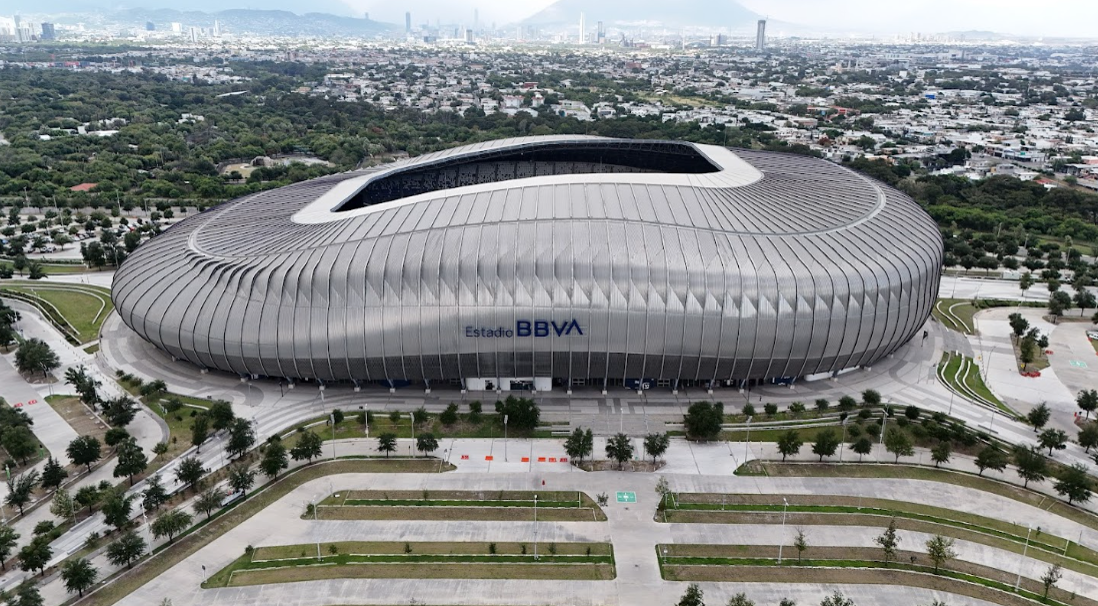
Estadio BBVA will be one of Mexico’s most modern venues at the FIFA World Cup 2026, hosting four matches in Monterrey, including a Round of 32 knockout fixture.
During the tournament, the stadium will be called Estadio Monterrey because FIFA uses neutral stadium names and removes corporate branding from World Cup venues. But to Liga MX fans, this is Estadio BBVA: the home of CF Monterrey and one of the most striking football stadiums in North America.
Opened in 2015, the venue is the youngest of Mexico’s three World Cup 2026 stadiums. It is also the most architecturally modern, with a steel-and-aluminium design inspired by Monterrey’s industrial identity and the surrounding Sierra Madre Oriental mountains.
Known as El Gigante de Acero, or The Steel Giant, Estadio BBVA combines a steep football bowl, a partial canopy, a hybrid GrassMaster pitch and dramatic views of Cerro de la Silla.
For World Cup 2026, the stadium will host three group-stage matches and one Round of 32 match. South Africa, South Korea, Tunisia and Japan are among the teams scheduled to play in Monterrey, giving the venue strong global and African interest.
Quick Facts About Estadio BBVA
| Fact | Detail |
|---|---|
| Stadium name | Estadio BBVA |
| FIFA World Cup name | Estadio Monterrey |
| Nickname | El Gigante de Acero |
| Location | Guadalupe, Monterrey metropolitan area, Nuevo León, Mexico |
| Address | Avenida Pablo Livas 2011, La Pastora, Guadalupe |
| Capacity | 53,500 |
| Opened | 2015 |
| Roof | Open-air with partial canopy |
| Surface | GrassMaster hybrid |
| Main tenant | CF Monterrey |
| Competition focus | FIFA World Cup 2026 |
| World Cup matches | 4 matches |
| Biggest match | Round of 32 |
| First World Cup match | June 14, 2026 |
| Known for | Steel design, Cerro de la Silla views, Clásico Regio and Monterrey heat |
Where Is Estadio BBVA?
Estadio BBVA is located in Guadalupe, a municipality within the Monterrey metropolitan area in the Mexican state of Nuevo León.
The stadium sits east of downtown Monterrey, near the La Pastora area and close to Cerro de la Silla, the saddle-shaped mountain that dominates the city skyline. The mountain is not just a backdrop. It directly influenced the stadium’s roofline and visual identity.
The venue is about 8 miles from central Monterrey and is connected by road, metro, bus and rideshare options. It is also within reasonable driving distance of General Mariano Escobedo International Airport.
For World Cup visitors, the location offers access to Monterrey’s industrial history, mountain scenery, food culture and urban attractions such as Parque Fundidora, Paseo Santa Lucía and Macroplaza.
History of Estadio BBVA
Estadio BBVA was built to replace Estadio Tecnológico, the longtime home of CF Monterrey.
Rayados had played at Estadio Tecnológico for more than six decades, but the club needed a modern venue with better facilities, stronger revenue potential and a more intense football atmosphere.
Construction began in August 2011. Four years later, Estadio BBVA opened on August 2, 2015, with the 8th Eusébio Cup. Monterrey beat Portuguese club Benfica 3-0 in front of a sold-out crowd.
The stadium immediately became one of the most admired venues in the Americas. Its design, mountain views and passionate fan base helped it stand apart from more generic modern stadiums.
Since opening, Estadio BBVA has hosted Liga MX matches, Clásico Regio derbies, CONCACAF Champions League finals, Mexico national team games and major concerts.
Construction and Design
Estadio BBVA was designed by Populous, working with Mexican studio VFO and Federico Velasco. The stadium was built by a joint venture involving Aceros Lozano, GGP and Maíz Mier.
The architecture is deeply connected to Monterrey. The metallic exterior reflects the city’s steel and industrial heritage, while the jagged roofline mirrors the shape of the Sierra Madre Oriental and Cerro de la Silla.
The partial canopy extends over the seating bowl, giving fans shade and some weather protection while keeping the venue open and naturally ventilated.
The seating bowl is steep, with a 34-degree rake that brings fans close to the pitch. The distance between the first row and the field is close to the minimum FIFA allows, creating an intense football environment.
That design helps make the stadium feel larger and louder than its 53,500 capacity suggests.
Estadio BBVA and World Cup 2026
Estadio BBVA will host four FIFA World Cup 2026 matches.
The schedule includes three group-stage matches and one Round of 32 fixture. The first match will be played on June 14, 2026, and the Round of 32 match is scheduled for June 29, 2026.
The venue will be branded as Estadio Monterrey during the tournament. That name will appear in FIFA broadcasts, ticketing, signage and official material.
Monterrey’s World Cup role is smaller than Mexico City’s but still important. Estadio Azteca will host the opening match, while Estadio BBVA gives northern Mexico a modern football stage.
The combination of heat, mountain scenery, passionate local support and a compact stadium bowl should make Monterrey one of the most distinctive stops of the tournament.
World Cup 2026 Matches at Estadio BBVA
| Date | Match |
| June 14, 2026 | UEFA Playoff B Winner vs Tunisia |
| June 20, 2026 | Tunisia vs Japan |
| June 24, 2026 | South Africa vs South Korea |
| June 29, 2026 | Winner Group F vs Runner-up Group C |
The South Africa vs South Korea match on June 24 will be especially important for African fans. It gives Bafana Bafana a second major Mexican venue storyline after the World Cup Opening Match in Mexico City.
Tunisia will also play twice at Estadio BBVA, first against the UEFA Playoff B winner and then against Japan. That makes Monterrey one of the most important World Cup 2026 host cities for African teams.
The Round of 32 match on June 29 will bring knockout football to Monterrey. By then, the group stage will be over and every match will carry elimination pressure.
Why Estadio BBVA Was Chosen for a Round of 32 Match
Estadio BBVA was chosen for World Cup 2026 because it is modern, football-specific and built for atmosphere.
The stadium has a strong pitch setup, steep stands, a partial canopy and a proven football culture through CF Monterrey. It is also located in one of Mexico’s most important cities.
A Round of 32 match requires reliable operations, strong security, broadcast infrastructure, team facilities and crowd control. Estadio BBVA is young enough to meet many of those modern standards without requiring the level of structural overhaul needed at older venues.
The stadium’s setting also helps. Cerro de la Silla gives Monterrey one of the most recognisable visual backdrops in the tournament.
For FIFA, Estadio BBVA offers something different: a modern Mexican stadium with local identity, rather than a neutral bowl.
The GrassMaster Pitch
Estadio BBVA uses a GrassMaster hybrid pitch.
GrassMaster combines natural grass with synthetic reinforcement fibres. This helps the surface stay stable under heavy use while preserving the feel of natural grass.
That matters during World Cup 2026 because Monterrey will host several matches in hot weather within a short period. The pitch must remain firm, even and safe for elite players.
The stadium’s under-turf ventilation and water-management systems are also important. Monterrey’s summer heat can stress grass, so pitch maintenance will be one of the key technical tasks during the tournament.
A strong surface will help teams play fast, technical football despite the climate.
Monterrey Heat and Match Conditions
Heat will be one of the biggest factors at Estadio BBVA.
Monterrey in June can be extremely hot, with temperatures often reaching levels that affect players and fans. Even evening matches may feel warm, especially when humidity is present.
FIFA has scheduled key matches in the evening to reduce heat stress, but conditions will still matter. Teams will need hydration plans, cooling strategies and careful training schedules.
Fans should prepare as well. Arriving early, drinking water, wearing light clothing and seeking shade before kickoff will be important.
The partial canopy provides some cover, but the stadium is still open-air. Heat will remain part of the Monterrey World Cup experience.
The Steel Giant Identity
Estadio BBVA’s nickname, El Gigante de Acero, means The Steel Giant.
The name fits both the stadium and the city. Monterrey built much of its modern identity around industry, manufacturing and steel. The stadium’s metallic exterior turns that history into architecture.
Unlike stadiums that could belong anywhere, Estadio BBVA looks like it belongs specifically in Monterrey. The steel, aluminium and mountain-inspired lines all point back to the city.
That local identity will matter during World Cup 2026. Global viewers will not just see a football venue. They will see a stadium that reflects its host city.
Clásico Regio and Football Culture
Estadio BBVA is home to CF Monterrey, one of Mexico’s major clubs.
The stadium’s fiercest matches come against Tigres UANL in the Clásico Regio. This derby is one of the most intense rivalries in Latin American football, with Monterrey and Tigres competing for city pride, regional dominance and national trophies.
When the derby is played at Estadio BBVA, the steep stands and close pitch create a powerful atmosphere. The crowd feels right on top of the players.
That local football culture gives the stadium credibility as a World Cup venue. Monterrey fans understand pressure, rivalry and big-match intensity.
International teams will step into a stadium that already knows how to host emotional football.
Major Events Hosted at Estadio BBVA
Since opening in 2015, Estadio BBVA has hosted more than regular Liga MX matches.
It has staged CONCACAF Champions League finals, Mexico national team matches, Copa MX events and major concerts. Coldplay drew huge crowds across two nights, showing the stadium’s ability to handle large entertainment productions.
The venue’s opening match against Benfica also gave it an international beginning. That helped establish it as more than a domestic club ground.
World Cup 2026 will be the stadium’s biggest global moment. At just over a decade old when the tournament arrives, it will represent the modern side of Mexican football infrastructure.
Transport and Fan Access
Metrorrey is the most practical public transport option for many fans going to Estadio BBVA.
Line 1 serves Exposición station, which is within walking distance of the stadium. From central Monterrey, the journey is manageable, but fans should expect crowds on match days.
Bus routes also serve the stadium area from different parts of the city. However, buses may be crowded and slower during World Cup events.
Fans should arrive early and avoid last-minute travel. Monterrey traffic can be heavy even on normal days, and World Cup match days will increase pressure around the stadium.
After the match, walking to a less crowded station or pickup point may save time.
Driving and Parking
Driving to Estadio BBVA is possible, but it requires planning.
The stadium is connected to Monterrey’s road network through Avenida Pablo Livas and nearby routes. Official parking is available, but spaces can fill quickly for major events.
Street parking is not recommended for visitors unfamiliar with the area. Official lots and authorised transport options are safer.
World Cup fans who drive should arrive early, follow official parking instructions and expect slow exits after full time.
Because heat can be intense, fans should also plan for time walking from parking areas to the stadium.
Rideshare and Airport Access
Uber and DiDi operate in Monterrey and will be useful for many World Cup visitors.
A ride from downtown Monterrey to the stadium is usually manageable, but surge pricing and traffic will increase around match times. Fans may want to get dropped several blocks from the stadium to avoid the worst congestion.
After matches, walking away from the stadium before requesting a ride may reduce waiting time and cost.
General Mariano Escobedo International Airport is the main airport for Monterrey. It is within driving distance of the stadium, but fans should allow extra time on match days.
Visitors flying in should avoid tight airport-to-kickoff schedules because immigration, traffic and security can all create delays.
Nearby Attractions
Estadio BBVA gives visitors access to some of Monterrey’s best-known attractions.
Cerro de la Silla is the city’s signature mountain and provides one of Mexico’s most recognisable urban backdrops. It is visible from parts of the stadium and nearby areas.
Parque Fundidora is a major urban park built on a former steel foundry site. It includes museums, walking paths, event spaces and the official FIFA Fan Festival location for Monterrey.
Paseo Santa Lucía connects Fundidora to downtown through a scenic riverwalk with restaurants and boat rides. Macroplaza, one of the largest public squares in the world, sits in central Monterrey and connects visitors to museums, churches and civic landmarks.
Together, these attractions make Monterrey a strong travel stop beyond match day.
What Fans Should Know Before Visiting
Fans attending World Cup matches at Estadio BBVA should prepare for heat, crowds and traffic.
Monterrey in June can be very hot. Fans should drink water, wear light clothing, use sun protection and avoid unnecessary time in direct sun before the match.
Public transport is useful, but it will be crowded. Driving can work, but parking and traffic will require patience. Rideshare may be convenient before matches but expensive and slow after full time.
Security will follow FIFA standards. Fans should check rules on bags, tickets, gate times and prohibited items before match day.
For the South Africa and Tunisia matches, African fans should expect strong interest from diaspora communities, travelling supporters and neutral fans following the continent’s teams.
Why Estadio BBVA Matters to African Fans
Estadio BBVA will be one of the most important World Cup 2026 venues for African football fans.
Tunisia will play two group-stage matches in Monterrey. South Africa will also play South Korea at the venue on June 24. That gives Estadio BBVA direct African relevance across three match days.
For Kenyan readers, this makes Monterrey a venue to watch closely. African teams will not just pass through the city; they could shape the group-stage story there.
Tunisia’s matches against the UEFA Playoff B winner and Japan could influence Group F qualification. South Africa’s match against South Korea could be vital in Group A, depending on earlier results.
If either African team advances, Monterrey may be remembered as part of its World Cup 2026 journey.
Why Estadio BBVA Is Important
Estadio BBVA is important because it represents modern Mexican football.
Estadio Azteca carries history. Estadio Akron brings Guadalajara’s football culture. Estadio BBVA brings Monterrey’s industrial identity, mountain setting and modern stadium design.
The venue is smaller than Mexico City’s Azteca, but it is more contemporary. Its steep stands, partial canopy and close pitch create a strong football environment.
The Round of 32 match gives the stadium knockout-stage importance, while its African group-stage fixtures give it continental relevance.
For World Cup 2026, Estadio BBVA will show a different side of Mexico: industrial, northern, modern and intensely football-minded.
Key Takeaways
- Estadio BBVA is located in Guadalupe, in the Monterrey metropolitan area.
- It will be called Estadio Monterrey during FIFA World Cup 2026.
- The stadium opened in 2015.
- It has a listed capacity of 53,500.
- It is home to CF Monterrey.
- The venue is open-air with a partial canopy.
- Estadio BBVA uses a GrassMaster hybrid pitch.
- It will host four World Cup 2026 matches.
- The first match is scheduled for June 14, 2026.
- The stadium will host a Round of 32 match on June 29, 2026.
- Tunisia will play two group-stage matches there.
- South Africa will face South Korea there on June 24.
- Monterrey heat will be a major factor for fans and players.
Frequently Asked Questions
Where is Estadio BBVA located?
Estadio BBVA is located at Avenida Pablo Livas 2011 in Guadalupe, within the Monterrey metropolitan area of Nuevo León, Mexico.
What will Estadio BBVA be called during World Cup 2026?
During the tournament, Estadio BBVA will be called Estadio Monterrey because FIFA uses neutral venue names.
What is Estadio BBVA’s capacity?
Estadio BBVA has a listed capacity of 53,500.
When did Estadio BBVA open?
Estadio BBVA opened on August 2, 2015.
Which team plays at Estadio BBVA?
Estadio BBVA is home to CF Monterrey, also known as Rayados.
Does Estadio BBVA have a roof?
The stadium is open-air but has a partial canopy that provides shade and weather protection for many seats.
What is the playing surface at Estadio BBVA?
Estadio BBVA uses a GrassMaster hybrid pitch, which combines natural grass with synthetic reinforcement fibres.
How many World Cup 2026 matches will Estadio BBVA host?
Estadio BBVA will host four matches during FIFA World Cup 2026.
Will Estadio BBVA host a World Cup knockout match?
Yes. Estadio BBVA will host a Round of 32 match on June 29, 2026.
Read Also: Estadio Azteca World Cup 2026 Guide: Capacity, Location, Matches and Opening Match Venue
Why is Estadio BBVA called The Steel Giant?
It is called El Gigante de Acero because its steel-and-aluminium design reflects Monterrey’s industrial steel heritage.
Conclusion
Estadio BBVA will give Monterrey a modern and intense stage at the FIFA World Cup 2026. With four matches, including a Round of 32 fixture, the stadium will play a meaningful role in Mexico’s tournament schedule.
The venue is smaller than Estadio Azteca but newer, sharper and more closely tied to its city’s modern identity. Its steel design, mountain views, steep stands and hybrid pitch make it one of the most visually distinctive stadiums in the competition.
For African fans, Monterrey will be especially important. Tunisia will play twice at Estadio BBVA, and South Africa will face South Korea there in a major Group A match.
Heat, transport and crowd movement will require planning, but the reward should be a powerful World Cup setting. When the tournament reaches Monterrey, Estadio BBVA will show the world why it is known as The Steel Giant.
Read Also: Estadio Akron World Cup 2026 Guide: Capacity, Location, Matches and Guadalajara Venue
