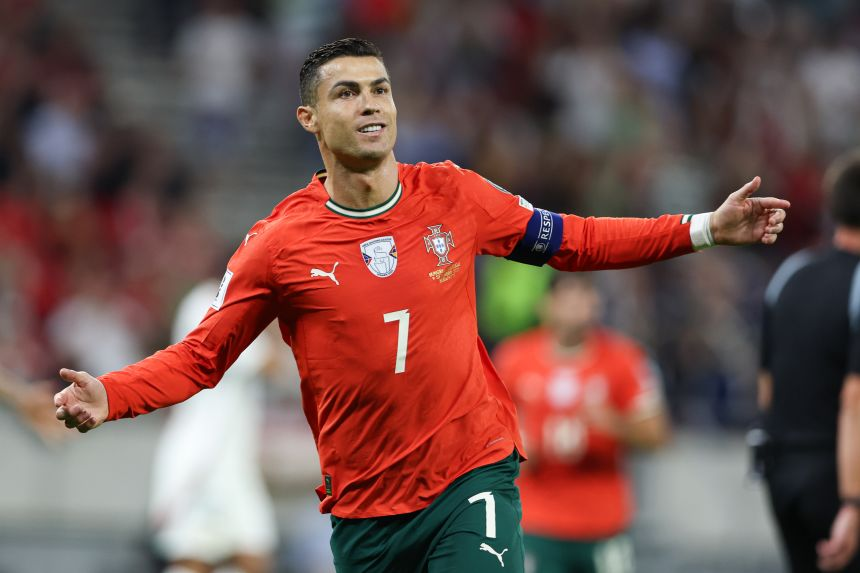
The list of footballers with 500 goals is where football greatness becomes almost impossible to ignore. It is not a ranking for one-season wonders, short-lived stars or players remembered only for talent. It is a table built on years of scoring, pressure, reinvention and survival at the highest level.
Cristiano Ronaldo leads the top-level all-time scoring list with 976 goals for club and country, according to the uploaded source updated as of July 7, 2026. Lionel Messi ranks second with 919 goals, while Pelé, Romário, Ferenc Puskás, Josef Bican and Robert Lewandowski complete the top seven in the same table.
The milestone is rare. The uploaded source states that 27 players have scored 500 or more goals in top-level association football competitions, according to IFFHS and other media outlets. When broader competitions at all levels are included, RSSSF credits 83 players with reaching the same mark.
That difference explains why all-time football scoring records remain so controversial. Some rankings count only top-level competitive goals. Others include wider historical records, regional matches, wartime fixtures, unofficial international games and club friendlies. FIFA has never released one official all-time list of the highest career goalscorers and does not keep a definitive record of this category.
Even with those disputes, the 500-goal club remains one of football’s most respected achievements. It brings together Ronaldo’s modern dominance, Messi’s Barcelona genius, Pelé’s global legacy, Puskás’ historic brilliance, Bican’s disputed scoring empire, Lewandowski’s modern No. 9 excellence and Harry Kane’s rise into elite company.
Footballers With 500 Goals: The Elite Scoring Standard
Footballers with 500 goals belong to a category that separates great attackers from historic scorers.
A player can become a legend at one club with 150 goals. A striker can dominate a league with 250. A forward can be remembered forever with 300 or 400. But reaching 500 requires more than a peak. It requires a career.
That is why the milestone matters. It measures consistency, not only talent. It rewards players who keep scoring after defenders study them, after injuries slow them, after managers change systems and after younger forwards arrive to challenge them.
A 500-goal player has usually scored in several different ways. He has finished counterattacks, converted penalties, found space inside crowded boxes, scored headers, punished mistakes, carried national teams and delivered under expectation. He has been asked to win matches, not only decorate them.
The uploaded source shows that this group stretches across football history. Imre Schlosser is generally recognised as the first footballer to reach the 500-goal mark, doing so in 1927 shortly before retirement. More than a century later, Ronaldo, Messi, Lewandowski, Suárez, Benzema and Kane are still pushing the modern end of the record.
That time span is what makes the list so fascinating. It is not a single-era ranking. It is football’s long scoring archive, from early European pioneers to global superstars whose every goal is filmed, clipped and shared within seconds.
The 500-goal club is therefore both statistical and cultural. It tells fans who scored the most, but also how football changed.
Cristiano Ronaldo: The Clear Modern Leader
Cristiano Ronaldo’s 976 goals place him first in the uploaded top-level ranking. His total includes 600 league goals, 57 cup goals, 173 continental goals and 146 goals in international and other listed categories.
That number is remarkable because Ronaldo’s career has crossed so many football environments.
He started at Sporting CP, became a global star at Manchester United, reached his greatest scoring peak at Real Madrid, continued his output at Juventus, returned to Manchester United, moved to Al Nassr and kept scoring for Portugal. Across those phases, his role changed dramatically.
Ronaldo began as a winger known for speed, tricks and one-on-one dribbling. He became a wide forward who attacked the box. At Real Madrid, he turned into one of the most devastating goalscorers in football history. Later, he adapted into a penalty-box striker whose movement, timing and heading remained decisive.
That ability to evolve explains why he leads the list. Many explosive young forwards fade when pace drops. Ronaldo did not. He changed his game, preserved his body and kept scoring into an age when most elite attackers have already retired or moved into minor roles.
His next target is 1,000 goals. The uploaded source notes that Ronaldo stated in 2024 that he wanted to reach 1,000 career goals before retirement, though media outlets have regularly questioned whether he can do it.
At 976, he is 24 goals away from the milestone in the uploaded top-level count. If he gets there, it would be one of the clearest modern scoring achievements in football because his total is built largely from documented senior competitive matches.
That is why Ronaldo’s record is so powerful. It combines volume, longevity and modern documentation.
Lionel Messi: The Scorer Who Was Also the Creator
Lionel Messi ranks second with 919 goals in the uploaded top-level table. His total includes 565 league goals, 71 cup goals, 158 continental goals and 125 goals across Argentina and other listed categories.
Messi’s place on the list is different from Ronaldo’s because his greatness was never limited to scoring. He is one of the greatest goal creators in football history, yet he also became one of its greatest finishers.
That combination makes Messi unique.
Most players who score at this level are defined primarily as finishers. Messi scored like a striker while playing like a playmaker. He dropped deep, carried the ball, created chances, controlled tempo and still finished seasons with numbers that pure forwards could only dream of.
The uploaded source also highlights Messi’s single-club record. He scored 672 goals for Barcelona, the highest number listed by one player for a single club.
That Barcelona record is one of football’s most secure modern achievements. It was built across La Liga, the Copa del Rey, European competitions and other official matches during an era of full media coverage and data tracking.
Messi’s goals were also stylistically diverse. He scored solo goals after dribbling through defences, curled shots from outside the box, delicate chips over goalkeepers, free-kicks, penalties, quick one-twos and late arrivals into the area.
His scoring record changed the way fans think about attacking roles. A player no longer had to be a classic No. 9 to dominate all-time scoring. Messi proved that a creative forward could also become one of the most prolific goalscorers ever.
If Ronaldo is the symbol of relentless scoring hunger, Messi is the symbol of total attacking genius.
Pelé and the Problem of Counting History
Pelé ranks third in the uploaded top-level table with 762 goals.
But Pelé’s place in all-time scoring history is much bigger than that single number. He has long been associated with totals above 1,000 goals, and his supporters argue that many of his friendly goals should not be dismissed because of the football context of his era.
The uploaded source explains that Santos, Pelé’s former club, disputed modern single-club goal comparisons by arguing that 448 of Pelé’s friendly goals had been uncounted. It also notes that Pelé supported a larger total by updating his tally to 1,283 on Instagram.
This is where football history becomes difficult.
In today’s game, friendlies are usually treated as low-stakes commercial or preparation matches. In Pelé’s era, Santos tours were major events. The club travelled globally and faced strong teams, often because fans around the world wanted to see Pelé. Some of those matches were not official league fixtures, but they carried serious sporting and commercial weight.
That creates two interpretations.
A strict statistical approach says only official competitive goals should count in all-time rankings. A historical approach says football in the 1950s, 1960s and 1970s cannot be judged only by modern competition structures.
Pelé’s legacy survives both approaches. Even if the stricter top-level table lists him at 762, he remains one of football’s most important scorers and the sport’s first truly global superstar.
His record reminds readers that numbers alone cannot capture every era fairly.
Romário, Puskás and Bican: The Debate Behind the Legends
Romário, Ferenc Puskás and Josef Bican sit directly behind Pelé in the uploaded ranking, with 756, 725 and 722 goals respectively.
Romário’s scoring record reflects the genius of a pure penalty-box finisher. He was sharp, composed and ruthless in small spaces. He did not need many touches to decide a match. His movement around defenders and calm finishing made him one of Brazil’s greatest forwards.
Like Pelé, Romário is linked to a disputed 1,000-goal claim. The uploaded source notes that Romário claimed his 1,000th goal in 2007 but later admitted the total included friendlies.
Puskás is one of the great icons of European football. His left foot became legendary, first with Hungary’s Mighty Magyars and later with Real Madrid. His 725 goals in the uploaded top-level table underline how prolific he was across two football worlds shaped by history, politics and migration.
Bican’s case is even more complicated. The uploaded source explains that FIFA recognised Bican in 2020 as a record scorer with an estimated 805 goals, while other sources credit him with different totals. RSSSF gives him 948 goals under broader criteria, while the Czech football authorities have claimed 821.
Bican’s totals vary because of the way wartime matches, regional selections, reserve-team goals and unofficial games are counted. Yet the disagreement over his exact number should not hide the broader truth: Bican was one of football’s most prolific scorers.
These three names show why football records cannot be reduced to one table. Romário, Puskás and Bican all belong in the conversation, but their exact positions depend on methodology.
Robert Lewandowski and the Last Great Classic No. 9
Robert Lewandowski ranks seventh in the uploaded top-level table with 697 goals.
That places him within touching distance of 700, a milestone that would strengthen his place among football’s greatest centre-forwards.
Lewandowski’s career is important because he represents the classic No. 9 in a modern tactical world. He is not mainly a winger, not primarily a playmaker and not a false nine in the Messi mould. He is a striker built around movement, anticipation, finishing and efficiency.
His career at Borussia Dortmund, Bayern Munich, Barcelona and Poland shows what a specialist scorer can still achieve in an era of pressing, rotation and tactical complexity.
Lewandowski’s scoring is not only about power. It is about detail. He moves before defenders react. He adjusts his body quickly. He finishes first time. He can score with both feet, his head, from crosses, cutbacks, rebounds and penalties.
His record also shows how high the Ronaldo-Messi standard became. Lewandowski has been one of the best strikers of his generation, scored heavily for many years and maintained elite professionalism. Yet he remains more than 200 goals behind Messi and nearly 300 behind Ronaldo in the uploaded table.
That does not diminish Lewandowski. It shows how exceptional the top two are.
Top 27 Footballers With 500 Goals
According to the uploaded top-level list, 27 players had reached 500 or more goals as of July 7, 2026.
| Rank | Player | Goals | Career Span |
|---|---|---|---|
| 1 | Cristiano Ronaldo | 976 | 2002–present |
| 2 | Lionel Messi | 919 | 2004–present |
| 3 | Pelé | 762 | 1957–1977 |
| 4 | Romário | 756 | 1985–2007 |
| 5 | Ferenc Puskás | 725 | 1943–1966 |
| 6 | Josef Bican | 722 | 1931–1955 |
| 7 | Robert Lewandowski | 697 | 2008–present |
| 8 | Jimmy Jones | 639 | 1947–1964 |
| 9 | Gerd Müller | 634 | 1964–1981 |
| 10 | Joe Bambrick | 626 | 1926–1943 |
| 11 | Abe Lenstra | 624 | 1936–1963 |
| 12 | Luis Suárez | 606 | 2005–present |
| 13 | Eusébio | 578 | 1960–1978 |
| 14 | Glenn Ferguson | 563 | 1987–2011 |
| 15 | Zlatan Ibrahimović | 561 | 1999–2023 |
| 16 | Imre Schlosser | 553 | 1906–1928 |
| 16 | Fernando Peyroteo | 553 | 1937–1949 |
| 18 | Uwe Seeler | 552 | 1954–1978 |
| 19 | Jimmy McGrory | 550 | 1923–1937 |
| 20 | Alfredo Di Stéfano | 537 | 1945–1966 |
| 21 | György Sárosi | 530 | 1931–1948 |
| 22 | Karim Benzema | 523 | 2005–present |
| 23 | Roberto Dinamite | 513 | 1971–1992 |
| 24 | Harry Kane | 511 | 2011–present |
| 25 | Hugo Sánchez | 506 | 1976–1997 |
| 26 | Franz Binder | 503 | 1930–1949 |
| 27 | Zico | 501 | 1971–1994 |
The table is dominated by forwards, but not by one type of forward. Some were classic centre-forwards. Others were inside-forwards, second strikers, wide attackers or creative forwards.
That variety makes the list more interesting. It shows that there is no single way to become an elite scorer. Ronaldo used athleticism, movement and reinvention. Messi used technique, timing and creation. Müller used penalty-box instinct. Suárez used aggression and improvisation. Benzema combined link play with late-career scoring power. Kane blends finishing with passing.
The 500-goal club rewards different football languages, but the final sentence is always the same: goals.
The Single-Club 500-Goal Record
One of the most impressive achievements inside the 500-goal club is scoring 500 goals for a single club.
The uploaded source lists nine players who achieved that mark: Josef Bican for Slavia Prague, Jimmy Jones for Glenavon, Jimmy McGrory for Celtic, Joe Bambrick for Linfield, Lionel Messi for Barcelona, Gerd Müller for Bayern Munich, Pelé for Santos, Fernando Peyroteo for Sporting Lisbon and Uwe Seeler for Hamburg.
Messi scored the most among them, with 672 goals for Barcelona.
This record may be harder to break than many fans realise. Modern football is less stable. Players move more often. Contracts are shorter. Clubs change projects. Agents manage careers globally. A player good enough to score hundreds of goals often attracts offers from several leagues.
That makes single-club scoring loyalty rare.
Messi’s Barcelona career was unusual because he became the centre of one of football’s greatest teams and stayed long enough to build a record that may last for decades. Pelé’s Santos career was equally iconic in a different era. Müller’s Bayern Munich goals helped build the club’s European identity.
Single-club scoring records carry a deeper emotional meaning. They belong to the supporters who grew up watching one player define their weekends, trophies and memories.
Luis Suárez, Benzema, Ibrahimović and Kane: The Modern Chasers
The modern section of the list is not only about Ronaldo, Messi and Lewandowski.
Luis Suárez is listed with 606 goals, Karim Benzema with 523, Zlatan Ibrahimović with 561 and Harry Kane with 511.
Each player brings a different scoring identity.
Suárez was chaos and genius combined. He scored at Ajax, Liverpool, Barcelona, Atlético Madrid, Inter Miami and Uruguay. His game mixed aggression, instinct, technique and unpredictability. At his peak, he was one of the few forwards capable of matching Messi and Ronaldo in short bursts of scoring dominance.
Ibrahimović’s 561 goals reflect one of football’s longest elite careers. He scored in the Netherlands, Italy, Spain, France, England, the United States and for Sweden. His record is built on power, technique, confidence and extraordinary durability.
Benzema’s 523 goals tell a story of late-career transformation. For years at Real Madrid, he was praised for creating space and linking play for Ronaldo. After Ronaldo left, Benzema became the central scorer and reached new individual heights.
Kane’s 511 goals make him one of the newest members of the elite top-level 500-goal group. His career is especially impressive because he is both a finisher and a creator. He drops deep, passes like a No. 10 and still scores like a traditional striker.
Kane may climb much higher if he stays fit. His inclusion proves that the 500-goal club is not closed to new names.
Gerd Müller, Eusébio and the Ruthless Finishers
Gerd Müller and Eusébio remain two of the greatest natural scorers in football history.
Müller is listed with 634 goals in the uploaded top-level table. Eusébio is listed with 578.
Müller’s style was not built on elegance. It was built on inevitability. He seemed to arrive exactly where the ball would land. He scored from close range, from awkward angles, under pressure and with defenders around him. His movement inside the box was one of football’s great weapons.
Eusébio was different. He combined explosive power, speed and shooting ability. The Benfica and Portugal legend became one of the defining forwards of the 1960s and remains one of the greatest African-born footballers in history.
Their presence in the 500-goal club is important because it shows that football has always valued different types of scoring greatness. Müller was the master of timing. Eusébio was the force of nature. Ronaldo later combined elements of both: athletic power and penalty-box movement.
Why the RSSSF List Changes the Conversation
The uploaded source also includes an RSSSF list that credits 83 players with at least 500 goals when competitions at all levels are considered.
This broader list places Erwin Helmchen first with 989 or more goals, Ronaldo second with 975, Josef Bican third with 950 or more, Ronnie Rooke fourth with 934 or more and Messi fifth with 925.
That is a very different ranking from the top-level table.
The reason is methodology. RSSSF includes a broader range of matches and historical competitions. This helps preserve older football records, especially from eras when national leagues and competition structures were not as standardized as today.
But it also makes direct comparison harder. A goal in a modern Champions League knockout match and a goal in a historic regional competition may both be recorded, but they do not always carry the same competitive context.
That does not mean the broader list is wrong. It means it is different.
For football writers and editors, this is crucial. Do not mix top-level and all-level totals without explaining the difference. A clean article should say which source and method it is using.
Why Football’s All-Time Scoring Debate Will Never Fully End
The all-time goals debate will probably never end because football history is too broad for one perfect list.
The uploaded source explains that statisticians and media disagree over friendlies, regional competitions, wartime games and unofficial matches. It also notes disputes around Bican, Pelé, Romário, Erwin Helmchen, Abe Lenstra, Ferenc Deák, Puskás, Seeler, Müller, Túlio Maravilha and Robert Lewandowski.
These disputes are not always about bias. They are often about historical reality.
Football in 1927 was not football in 2026. Clubs did not always play the same competition structures. Records were not kept with the same precision. Some matches that would now be called friendlies were major events. Some wartime leagues were disrupted but still meaningful to players and fans.
The challenge is fairness.
If writers count too narrowly, they risk erasing older football. If they count too broadly, they risk inflating totals with games that were not comparable to elite competitive matches.
That is why the best approach is transparency. State the source. State the method. Explain the limits.
Ronaldo can be called the leading top-level scorer. Messi can be called the greatest single-club scorer. Pelé can be recognised as a global icon whose wider tally remains debated. Bican can be recognised as a historic scoring giant with several disputed totals.
Football history is richer when those differences are explained, not hidden.
What the 500-Goal Club Teaches the Next Generation
The 500-goal club teaches young players that greatness is not built only on talent.
Every player in this group had talent. But talent alone does not score 500 goals. The milestone requires habits.
It requires fitness. Players must stay available for hundreds of matches.
It requires mentality. Scorers miss chances, face criticism and go through droughts. The best continue attacking the next opportunity.
It requires adaptation. Ronaldo changed roles. Messi changed zones. Benzema changed responsibility. Kane changed the way English strikers are judged by adding elite passing to elite finishing.
It requires tactical intelligence. Great scorers know when to run, when to wait, when to drop, when to press and when to attack space.
It requires service. No player scores 500 alone. Teammates create chances, managers build systems and clubs provide platforms.
That is why the milestone is so respected. It reflects individual brilliance inside a collective sport.
Frequently Asked Questions
Who has the most goals in football history?
Cristiano Ronaldo leads the uploaded top-level table with 976 goals as of July 7, 2026. He is followed by Lionel Messi with 919 goals.
How many footballers have scored 500 goals?
The uploaded source lists 27 players with at least 500 goals in top-level professional football. It also says RSSSF credits 83 players with 500 or more goals when competitions at all levels are counted.
How many goals does Ronaldo have?
Cristiano Ronaldo is listed with 976 goals in the uploaded source.
How many goals does Messi have?
Lionel Messi is listed with 919 goals in the uploaded source.
Who has scored the most goals for one club?
Lionel Messi holds the listed single-club record with 672 goals for Barcelona.
Did Pelé score more than 1,000 goals?
Pelé has been associated with a total of 1,283 goals, but that figure includes friendly goals and other debated matches. The uploaded top-level table lists him with 762 goals.
Why are Bican’s goals disputed?
Josef Bican’s total changes depending on whether wartime goals, reserve-team goals, regional selections and unofficial matches are counted. The uploaded source shows several different totals used by different organizations and sources.
Is Harry Kane in the 500-goal club?
Yes. Harry Kane is listed with 511 goals in the uploaded top-level table.
Can Ronaldo reach 1,000 goals?
Ronaldo is listed with 976 goals, meaning he is 24 short of 1,000 in the uploaded top-level count. Whether he reaches the milestone depends on fitness, match time and how long he continues playing.
Conclusion
The footballers with 500 goals list is more than a ranking. It is a story of football’s greatest finishers, biggest debates and longest careers.
Cristiano Ronaldo leads the top-level table with 976 goals and is now close to the 1,000-goal milestone. Lionel Messi follows with 919 goals and owns the strongest modern single-club record through his 672 goals for Barcelona. Pelé, Romário, Puskás, Bican, Lewandowski, Müller, Eusébio, Suárez, Benzema and Kane all add their own eras and styles to the record.
The list also shows why football history is complicated. FIFA does not maintain one official all-time scoring list. IFFHS-style top-level records and RSSSF’s broader all-level records produce different rankings. Goals from friendlies, wartime matches, regional competitions and unofficial fixtures remain disputed.
That uncertainty does not weaken the achievement. It makes the story richer.
To score 500 goals is to dominate time. It means a player stayed dangerous season after season, survived pressure and kept finding the net when every opponent knew the threat.
Ronaldo may now be chasing 1,000, but the 500-goal club itself remains one of football’s purest symbols of greatness. It connects the earliest scoring pioneers to the modern icons of the game and reminds every fan of the simplest truth in football: goals create legends.
